Thursday, May 5, 2011

CIA spied on bin Laden from safe house

CIA spied on bin Laden from safe house

The CIA maintained a safe house in the Pakistani city of Abbottabad for a small team of spies who conducted extensive surveillance over a period of months on the compound where Osama bin Laden was killed by U.S. Special Operations forces this week, U.S. officials said.

The secret CIA facility was used as a base of operations for one of the most delicate human intelligence gathering missions in recent CIA history, one that relied on Pakistani informants and other sources to help assemble a “pattern of life” portrait of the occupants and daily activities at the fortified compound where bin Laden was found, the officials said.

The on-the-ground surveillance work was part of an intelligence-gathering push mobilized after the discovery of the suspicious complex last August that involved virtually every category of collection in the U.S. arsenal, ranging from satellite imagery to eavesdropping efforts aimed at recording voices inside the compound.

The effort was so extensive and costly that the CIA went to Congress in December to secure authority to reallocate tens of millions of dollars within assorted agency budgets to fund it, U.S. officials said.

Most of that surveillance capability remained in place until the execution of the raid by U.S. Navy SEALs shortly after 1 a.m. in Pakistan. The agency’s safe house did not play a role in the raid and has since been shut down, in part because of concerns about the safety of CIA assets in the aftermath, but also because the agency’s work was considered finished.

“The CIA’s job was to find and fix,” said a U.S. official, using Special Operations forces terminology for the identification and location of a high-value target. “The intelligence work was as complete as it was going to be, and it was the military’s turn to finish the target.”

The official, like others quoted for this article, spoke on the condition of anonymity because they were not authorized to speak for the record. The CIA declined to comment.

U.S. officials provided new details on bin Laden’s final moments, saying the al-Qaeda leader was first spotted by U.S. forces in the doorway of his room on the compound’s third floor. Bin Laden then turned and retreated into the room before being shot twice — in the head and in the chest. U.S. commandos later found an AK-47 and a pistol in the room.

“He was retreating,” a move that was regarded as resistance, a U.S. official briefed on the operation said. “You don’t know why he’s retreating, what he’s doing when he goes back in there. Is he getting a weapon? Does he have a [suicide] vest?”

Despite what officials described as an extraordinarily concentrated collection effort leading up to the operation, no U.S. spy agency was ever able to capture a photograph of bin Laden at the compound before the raid, or a recording of the voice of the mysterious male figure whose family occupied the structure’s top two floors.

Indeed, current and former U.S. intelligence officials said that bin Laden employed remarkable discipline in his efforts to evade detection.

“You’ve got to give him credit for his tradecraft,” said a former senior CIA official who played a leading role in the manhunt. When spotted by surveillance drones a decade earlier, bin Laden “had bodyguards, multiple SUVs and things like that. He abandoned all of that.”

The officials also outlined emerging theories as to why bin Laden apparently selected the Pakistani military garrison city of Abbottabad as the place that afforded him the greatest chance to stay alive.

The discovery of bin Laden in Abbottabad has raised suspicion that he was placed there and being protected by elements of the Pakistani military and intelligence service, but U.S. officials said they have seen no conclusive evidence that was the case.

The city, about two hours north of Islamabad by car, offered a number of advantages for the al-Qaeda leader, officials said. Chief among them is that Abbottabad, deep inside Pakistan’s borders, is a safe distance from the tribal regions that are patrolled by armed U.S. drones.

U.S. officials said they are convinced that bin Laden, who had long immersed himself among the Pashtun tribes along the border with Afghanistan, was driven from that part of the country by the escalating drone campaign.

“Even five years ago things were dropping from the sky” in Pakistan’s tribal region, a U.S. official said. “He probably felt that if he could conceal his presence [in Abbottabad] it would be an unlikely area for the United States to pursue him.”

Strikes by conventional U.S. aircraft would have carried enormous risks, both because Pakistan has invested heavily in air detection and defense systems — to counter any threat posed by India — and because of the perils of an errant strike.

“All it has to be is about 1,000 yards off and it hits the Pakistan Military Academy,” said a CIA veteran of Afghanistan and Pakistan. The city is also home to two regimental compounds, and suburbs occupied by military families.

U.S. officials said there were also disadvantages for bin Laden in residing in Abbottabad, including the fact that the area is relatively welcoming to outsiders, including Pakistanis on vacation, military families being transferred to bases there, and even U.S. soldiers who have at times been sent to Abbottabad to train Pakistani troops.

“Abbottabad is not a place where Islamic extremists went, because it wasn’t a stronghold,” said the former U.S. intelligence official involved in the bin Laden pursuit. “They preferred places like Peshawar, Quetta or Karachi.” When analysts would consider likely locations for the al-Qaeda chief, the official said, “Abbottabad wouldn’t be on that list.”

The CIA took advantage of that atmosphere to send case officers and recruited informants into Abbottabad undetected, and set up a safe house that functioned as its base.

“That is an Achilles heel for bin Laden, because anybody can go” to Abbottabad, the former CIA official said. “It makes it easier for the CIA to operate.”

U.S. officials declined to say how many case officers or informants used the facility, but they stressed that the effort required extraordinary caution because of the fear that bin Laden and those sheltering him might vanish again if spooked.

The CIA began to focus on the compound last summer after years of painstaking effort to penetrate a small network of couriers with ties to the al-Qaeda leader. Once the most important of those couriers led them to the Abbottabad compound, the conspicuous nature of the complex sent up alarms that it might have been built for bin Laden himself.

“The place was three stories high and you could watch it from a variety of angles,” the former official said. Moving into the custom-made compound, the former official said, “was his biggest mistake.”

When a team of two dozen commandos arrived at the site Monday, one of bin Laden’s couriers was the only enemy to open fire, officials said. “They had to blow through some doors and walls,” said the U.S. official briefed on the raid. “One door they opened up only to find a [cement] wall behind it.”

The SEALs encountered no other armed opposition as they ascended to the top floor, where bin Laden was found. “He was in the doorway and then retreated, and that’s where the operators moved in,” the senior U.S. official said.

Staff researcher Julie Tate contributed to this report. Special correspondent Haq Nawaz Khan in Abbottabad contributed to this report.

Judge won't keep Loughner records confidential

Judge won't keep Loughner records confidential

An artist's depiction shows Jared Lee Loughner (L), the Arizona man accused of shooting 20 people while trying to assassinate U.S. Representative Gabrielle Giffords over the weekend, and his attorney public defender Judy Clarke during a court appearance in Phoenix, Arizona January 10, 2011. REUTERS/Joan Andrew

PHOENIX | Thu May 5, 2011 6:07pm EDT

(Reuters) - A judge has denied a bid by defense lawyers to keep confidential information about Tucson shooting suspect Jared Loughner's behavior while in federal custody.

District Court Judge Larry Burns, in a ruling made public on Thursday, said there is no reason to prohibit the U.S. Bureau of Prisons from releasing to law enforcement and federal prosecutors psychological records and other information about the 22-year-old college dropout.

Loughner's lawyers said such a release would violate the federal government's own guidelines and Loughner's constitutional right to protection from self-incrimination and due process.

"The Court finds that neither the psychotherapist-patient privilege nor the Fifth and Sixth Amendments bar the disclosure of this information to the Government," Burns wrote in rejecting that argument.

Loughner is accused of opening fire outside a Tucson grocery store on January 8, killing six people and wounding 13 others, include U.S. Representative Gabrielle Giffords.

The Arizona congresswoman was shot through the head, and remains at a rehabilitation center in Houston.

Loughner has pleaded not guilty to 49 charges, including two counts of first degree murder of a federal employee, for the deaths of a judge and a Giffords aide.

Justice Department officials have not determined whether to seek the death penalty.

Loughner was returned to Arizona late last month from Missouri, where he was sent to undergo mental exams to see if he was competent to stand trial and aid in his defense.

A competency hearing is scheduled for May 25 in Tucson.

'Home Alone' House for Sale for $2.4 Million

'Home Alone' House for Sale for $2.4 Million


Courtesy Coldwell Banker

To prevent gawkers and fans of John Hughes’ 1990 film, there will be no open houses and all buyers will be pre-screened.

The house made famous by Home Alone is on the market in suburban Chicago for $2.4 million.

The 4,250-square-foot Georgian, located in Winnetka, has 14 rooms, 3.2 baths, a screened-in porch and that famous staircase Macaulay Culkin slid down in the movie, the Chicago Tribune reports. It sits on a half-acre of land. PHOTOS: What iconic landmarks look like today

“The $2.4 million isn’t just because of its cinematic history,” says listing agent Marissa Hopkins of Coldwell Banker Residential Brokerage. “It really is a residential masterpiece.”

Emptynesters John and Cynthia Abendshien, who bought the home in 1988 for $875,000 admit now might not be the best time to sell given the housing market. But "we just decided we wouldn’t wait any longer,” Cynthia tells the Tribune. PHOTOS: Famous homes of Hollywood

To prevent gawkers and fans of John Hughes’ 1990 film, there will be no open houses and all buyers will be pre-screened.

"It would be a zoo,” Hopkins says. “There are a lot of people who would like to see the Home Alone house if they were given the opportunity.” PHOTOS: The next big stars

In related news, Chicago-area home featured in Ferris Bueller's Day Off has been taken off the market. The Highland Park house was originally listed at $2.3 million, but had most recently been offered for $1.65 million, says Coldwell Banker agent Meladee Hughes.

Stocks tumble on job report worries

Stocks tumble on job report worries

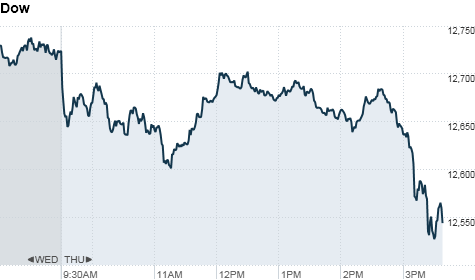
chart_ws_index_dow.top.png

Click the chart for more market data.

By Ben Rooney, staff reporter


NEW YORK (CNNMoney) -- A sell-off on Wall Street accelerated late Thursday as oil prices plunged and investors braced for the government's monthly jobs report.

The Dow Jones industrial average (INDU) fell 140 points, or 1.1%, according to early tallies. The S&P 500 (SPX) was down 12 points, or about 9%. The Nasdaq (COMP) sank 13 points, or 0.5%.

The broad-based retreat was sparked by weakness in shares of energy companies as oil prices plunged 8%, falling below $100 a barrel. It was the largest one-day decline since April 2009.

"The selling has been concentrated in the energy sector, and that pulled the entire market down," said Nick Kalivas, vice president of financial research at MF Global.

But the retreat turned into a full-blown sell-off late in the day as investors turned cautious ahead of Friday's report from the Labor Department on hiring and unemployment.

"People are not willing to take a stab on the long side ahead of the payrolls report," said Kalivas.

Friday's report is expected to show employers added 185,000 jobs in April, according to economists surveyed by CNNMoney. The unemployment rate is forecast to remain unchanged at 8.8%.

The government reported Thursday that the number of Americans filing first-time claims for unemployment benefits rose sharply last week. Labor Department officials said the increase was due to seasonal anomalies, but jobless claims have been on the rise recently.

Stocks ended in the red Wednesday, as disappointing reports on jobs and the service sector weighed on investors.

Currencies and commodities: The dollar rallied 2% against the euro after dovish comments from the president of the European Central Bank.

The dollar gained 1.5% versus the Australian dollar and rose 0.7% on the pound. But it eased against the yen.

The stronger dollar weighed on prices for commodities that are priced in the U.S. currency.

Oil prices sank $9.44, or 8.6%, to $99.80 a barrel.

Gold futures for June delivery fell $26.30, or 1.7%, to settle at $1,489 an ounce.

Silver futures for July delivery extended their retreat, sliding $2.58, or 6.7%, to $36.80 an ounce. Just a week ago, silver prices were within spitting distance of breaching $50 an ounce.

Investors had been plowing money into commodities this year, based on expectations that the dollar would remain weak as interest rates rise in Europe but remain low in the United States.

"That whole trade is looking pretty bad now," said Dan Greenhaus, market strategist at Miller Taback & Co. "Things are getting worse as the commodity selloff accelerates."

Companies: Automaker General Motors (GM, Fortune 500) reported a first-quarter net profit of $3.2 billion, its fifth consecutive profitable quarter. Shares fell about 2%.

JDS Uniphase (JDSU) reported mixed quarterly results but issued a sales outlook for the current quarter that topped analysts' forecasts. Shares of the networking equipment maker were up 9%.

Shares of Whole Foods (WFMI, Fortune 500) rose 1% a day after the company reported solid results after Wednesday's closing bell and raised its outlook.

Dow component Kraft Foods (KFT, Fortune 500) reports quarterly results after Thursday's close, with analysts expecting earnings of 47 cents a share.

Fox ends contracts of Gingrich, Santorum

May 05, 2011

Fox ends contracts of Gingrich, Santorum

Fox News has terminated its contracts with former Speaker Newt Gingrich and former Senator Rick Santorum after the deadline for them to decide on presidential bids passed on May 1, a source familiar with the move told POLITICO.

Fox suspended the two contributors in early March and stopped paying them as they mulled presidential runs, but left them the option of returning to the network. The contracts' end marks another sign that Gingrich, who has repeatedly delayed his decision citing business obligations, is in the race -- though he dropped out of tonight's Fox debate.

The network may also intensify the network's pressure on Mike Huckabee, the host of a Fox show, to make up his mind about a possible bid.

House Republicans back away on Medicare

House Republicans back away on Medicare

Vice President Joe Biden hosts a meeting with congressional Republicans and Democrats at Blair House, May 5, 2011. REUTERS/Jason Reed

WASHINGTON | Thu May 5, 2011 2:49pm EDT

(Reuters) - Republicans in Congress on Thursday appeared to back away from a contentious plan to overhaul Medicare, saying the fate of the healthcare program for the elderly may have to wait until after the 2012 elections.

As Vice President Joe Biden hosted bipartisan White House talks on cutting the $1.4 trillion U.S. deficit, House of Representatives Ways and Means Committee Chairman David Camp said his committee would not move forward on a Republican plan to privatize Medicare because it was not likely to win support from Democrats.

At the same time, the Medicare plan's author, House Budget Committee Chairman Paul Ryan, said Republicans hoped to achieve some spending cuts in budget negotiations but predicted that broad changes would not be in play until after 2012.

"We're not under any illusion that we are going to get any grand slam agreement," Ryan said.

The comments could suggest a new pragmatic tone by Republicans in budget negotiations taking place as Congress faces an August 2 deadline for raising the $14.3 trillion debt ceiling or risk defaulting on its obligations, an outcome that could devastate world financial markets.

The debt limit, which will be reached by May 16, has been seen as a Republican lever for pressuring President Barack Obama and Democratic lawmakers into accepting deep cuts in federal spending as well as Ryan's plan to convert the Medicare system into a system of government funded healthcare vouchers.

Democrats planned to campaign on Ryan's politically risky Medicare plan in the 2012 election campaign, seeing it as a potential vote loser for their opponents. If Republicans agree to put the plan aside that would remove a potential weapon in the Democrats' election arsenal.

FINDING A WORKABLE PLAN

Republicans encountered voter anger over the plan during Congress' annual spring break, which ended this week, potentially raising the prospects for a compromise agreement.

But House Republican Leader Eric Cantor said on Wednesday he still intended to press for the provisions of the Ryan 2012 budget plan, which includes Medicare reform, during Thursday's White House deficit talks.

Ryan's budget plan has already passed the Republican-controlled House.

Camp, who chairs the House's main tax-writing body, said in a speech he would now rather have a compromise on Medicare that could survive a vote in the Democratic-controlled Senate and win approval from Obama.

"I'm interested in finding a way forward that will get signed into law," he said at an event sponsored by Health Affairs, a health policy journal.

Ryan acknowledged in a speech to the American Council for Capital Formation that Republicans and Democrats were too far apart on how to slow the growth of Medicare and other government-run health programs to reach agreement before 2012.

"I think 2012 is going to be the ultimate decider of these things. There are other things that can be done to make improvements, and that's what I think this debt limit debate is about," he said.

President's bin Laden speech could have gone differently

President's bin Laden speech could have gone differently


Ed Sullivan Show, June 11, 1967