Friday, November 26, 2010

Sarah Palin sees elitism behind GOP swipes aimed at her

Sarah Palin sees elitism behind GOP swipes aimed at her

She describes Barbara Bush as a 'blueblood' after the former first lady dismisses her during a Larry King interview. Laura Ingraham says she fears Republican 'elites' are trying to 'knee-cap' potential challengers.

Barbara Bush and Sarah Palin
Palin is spinning a perceived slight by former First Lady Barbara Bush as another example of "elites" taking sides against her. (Larry W. Smith / EPA, Steve Pope / EPA)

As speculation over a potential presidential run by Sarah Palin grows more intense, the former vice presidential nominee of the Republican Party lately finds herself dealing with a surprising case of friendly fire.

In the latest example, Palin is spinning a perceived slight by former First Lady Barbara Bush as another example of "elites" taking sides against her.

In an interview with CNN's Larry King, Bush was asked about her view of the former Alaska governor.

"I sat next to her once, thought she was beautiful, and I think she's very happy in Alaska. And I hope she'll stay there," she said.

Conservative radio host Laura Ingraham played that sound bite as she welcomed Palin on her show. Ingraham said she feared "elites" were attempting to preemptively disqualify, or "knee-cap," potential Republican candidates.

Asked for her view, Palin said they "don't understand competition is good," and that it was wrong to "shoot internally."

"I think the majority of Americans don't want to put up with the bluebloods -- and I say it will all due respect because I love the Bushes – but the bluebloods who want to pick and chose their winners instead of allowing competition," Palin said, reacting to Bush's comment specifically. "I don't know if that kind of stuff is planned out, but it is what it is."

As the comment surfaced on Twitter, a Palin associate pushed back against the notion she was playing class warfare.

"She also said, 'no offense' to the Bushes. They are in fact the definition of bluebloods," Rebecca Mansour tweeted.

In her radio interview, Ingraham played a clip from another Republican, New Jersey Gov. Chris Christie, who seemed to scoff at the idea of a Palin presidency.

Asked in an interview with "Late Night" host Jimmy Fallon if Palin could win, Christie laughs as he says, "Who knows, Jimmy. It's an amazing world."

"Hopefully what he's saying is this is an amazing country where anybody's work ethic and character can be judged appropriately," Palin said in response.

Palin is promoting her new book, "America By Heart," released Tuesday. That has only ratcheted up the already frenzied speculation among political insiders about Palin's future.

In an interview with Barbara Walters last week, Palin said she felt she could defeat President Obama in 2012 if she were nominated. Walters, in a new interview with Obama, asked him what he thought.

"You know, I don't speculate on what's going to happen two years from now," he said.

"You will not tell me that you think you could beat Sarah Palin?" Walters asked.

"What I'm saying is, I don't think about Sarah Palin," Obama said with a smile.

mmemoli@tribune.com

Britain's austerity plan leaves many bracing for painful changes

Britain's austerity plan leaves many bracing for painful changes

Prime Minister David Cameron plans to slash $128 billion in spending over four years, upending a culture of governmental responsibility in a nation that provides everything from free healthcare to aid for mothers.

By Henry Chu, Los Angeles Times
8:19 PM PST, November 25, 2010
Reporting from Wimbledon, England


Britain is about to undergo an extreme makeover. And Festus Grant is worried.

The 71-year-old was crippled by a stroke early this year, and he doesn't know how he would have coped without the "angel of mercy" who knocked on his door a few days after he came home to his modest flat after three months in the hospital.

The care worker from the Stroke Assn. helped him piece his life back together. She arranged follow-up trips to the doctor and signed him up for a shuttle service that takes him shopping once a week.

But her visits are set to end in a month. Funding for her program is being axed, a victim of budget cuts by the local authority.

"She has been there for me.... I wouldn't know where to go, what to do," said Grant, who walks with difficulty and whose right arm is nearly useless. "Her work is very important, not just for me now, but others who will follow me."

The cutback is part of the most stinging national austerity plan in decades, one that will shrink the British state to a degree not even former Prime Minister Margaret Thatcher, with her passion for small government, was able to accomplish 30 years ago.

Britain's ruling coalition, led by the Conservative Party, insists that such a drastic retrenchment is necessary because years of free spending under the previous Labor government have left the nation broke. To erase a soaring budget deficit, the coalition intends to gouge a whopping $128 billion from the public purse in four years.

The sweeping plan has earned some admirers across the Atlantic, where some lawmakers are considering applying similar shock therapy in the U.S.

On the ground here in Britain, though, residents are bracing themselves for painful changes that will touch virtually every part of the country, and almost every aspect of life. Since the end of World War II, Britons have looked to the state for everything from free healthcare to financial assistance for mothers, a culture of governmental responsibility that's about to be upended.

In the northern city of Manchester, the police force will have to get rid of nearly 3,000 employees, including hundreds of officers, over the next four years. In southern England, in London and neighboring Kent, scores of libraries are at risk of being shut down, as are parks and recreation centers.

Welfare spending will be slashed by 8%, with limits placed on benefits for some long-term unemployed and chronically ill people. Legal aid to the poor is being scaled back, money to build affordable housing will be halved, and some homeless shelters will close.

For the old, meals on wheels and other community care services are in jeopardy. For the young, sports programs will be eliminated, even as the country gears up to host the Summer Olympics in London in 2012.

The military is downsizing; so is the prison system. Universities will lose professors, the arts will be squeezed and nearly 500,000 public sector jobs are on the chopping block, adding to the 2.5 million people already out of work.

"Cuts at these levels are unprecedented, and far, far exceed anything Margaret Thatcher achieved," political commentator and author John Lanchester wrote recently in the Guardian newspaper.

Most of the cuts, unveiled last month, have yet to come into force. So far, a majority of Britons seem to accept the need for some belt-tightening to get the nation's books in order.

But as state workers start receiving pink slips, as financially strapped parents dig deeper into their pockets to buy school uniforms for their kids, as elderly shut-ins miss out on regular home visits from caregivers, that "keep calm and carry on" attitude may fade. Already, tens of thousands of students have marched on London twice to protest — sometimes violently — planned increases in college tuition fees.

"There is an incredible sense of anger that is beginning to build up, and that anger can explode and manifest itself in all kinds of different ways," Len McCluskey, the head of Britain's largest union, warned this week.

Prime Minister David Cameron, who took power in May, is gambling that by front-loading as much of the cuts as possible, he's bought his government some time for the public to grow accustomed to the new reality, that economic growth will revive and that voters will be in a forgiving mood by the next election in 2015. Cameron is promoting a new, if still fuzzy, vision of Britain called the Big Society, which calls on residents to rely less on the state and instead engage in community volunteerism. But critics deride it as a shiny gloss on replacing basic public services with do-it-yourself government.

By ordering deep cuts, Britain is aligning itself with other European nations, such as Spain and Germany, that have introduced similar austerity plans to mollify international investors worried over government indebtedness.

But Alan Johnson, Labor's finance spokesman, told lawmakers to look closer to home, across the Irish Sea, for a devastating preview of the consequences of cutting too much too soon. In December, Ireland's finance minister declared that the markets and organizations such as the International Monetary Fund supported Dublin's massive budget cuts.

"He told the Irish Parliament that his austerity plan meant that they had turned the corner," Johnson said. "Four months later, they slid back into recession."

In a humiliating about-face, Dublin decided this week to apply for an international bailout expected to cost more than $100 billion.

Here in Britain, among the hardest hit by the budget cuts will be the country's regional police constabularies.

Manchester's police chief, Peter Fahy, has the grim task of eliminating 2,950 posts, including some through the forced retirement of senior officers. Reducing the workforce by nearly a quarter should save about $211 million over the next four years.

"I've been a police officer for 30 years," Fahy said. "I've never had to stand up in front of my staff and deliver that sort of message. There were tears."

Farther north, in Newcastle-upon-Tyne, Joyce Matthews has watched children boost their self-esteem and shun their couch-potato ways through a national sports program that helps build school PE offerings, runs after-school sports clubs and organizes meets. The program covers 35,000 students in Newcastle, a historic city built on the coal industry.

Matthews is the first to acknowledge that plenty of bureaucratic fat could be trimmed from the $256-million program. But neither Matthews nor any of her colleagues in the program anticipated the news that eventually came down.

"We were probably prepared, worst-case scenario, for 50% funding cuts," Matthews said. "We hadn't expected 100%."

Grant, the stroke victim, is nervously awaiting word next April as to whether his modest pension of about $1,800 a month will be reduced.

The former subway driver is proud of the fact that he was never without a job from his teens until his retirement six years ago. He now lives in public housing here in quiet Wimbledon, a stone's throw from where the annual tennis tournament is held.

Rent costs him a little less than $800 a month, about the limit he can afford. But the government is allowing some public-housing rents to rise closer to market rates, part of a wide-ranging overhaul of the housing-benefits system. It's not clear whether Grant will be affected.

But life already looks more precarious without the help of his advisor from the Stroke Assn. Any downgrading of his financial situation would seriously tarnish what he had hoped would be his golden years.

"I don't want to be a nuisance to anybody," Grant said with typical British reserve, before adding, "If they take more from me … I won't be able to survive."

Monday, November 22, 2010

Nuclear treaty row could harm US foreign policy: analysts

Nuclear treaty row could harm US foreign policy: analysts

Medvedev urges US Senate to be 'responsible' on STARTLisbon (AFP) Nov 20, 2010 - Russian President Dmitry Medvedev on Saturday urged the US Senate to ratify the START nuclear arms treaty, warning that his country would withhold its own ratification until it passes in Washington. "I hope that US legislators will demonstrate a responsible approach," Medvedev told a news conference in Lisbon following the first NATO-Russia summit in more than two years. "It would be a shame" if the treaty was not ratified, he said. "We will act in symmetry to what is happening in the US," Medvedev added, indicating Russian lawmakers would only rubber-stamp the treaty after the US Senate does. Medvedev said he spoke to US President Barack Obama during the summit about efforts to convince the Senate to ratify the treaty before the end of the year.

"He told me he was going to work actively in this direction with the Congress," the Russian leader said. "I hope this work will be crowned with success because if it can't move forward here then the world understandably would not become a safer place. I am convinced that common sense will triumph at the end of the day," he said. Obama has urged lawmakers to sign off on the Strategic Arms Reduction Treaty this year, before a new Congress takes over next year after Republicans routed his Democratic party in mid-term elections. European allies rallied to Obama's side during a two-day NATO summit in Lisbon, warning any delay in the ratification would endanger Europe's security. The treaty -- signed by Medvedev and Obama in April -- restricts each nation to a maximum of 1,550 deployed warheads, a cut of about 30 percent from a limit set in 2002. It would also see the return of US inspectors, who have not monitored Russia's arsenal since the agreement's predecessor lapsed in December 2009.
by Staff Writers Washington (AFP) Nov 21, 2010 Uncertainty over ratifying a landmark nuclear treaty not only throws into doubt the "reset" in US-Russia ties but also broader US policies on Iran, Afghanistan and arms control, analysts say. US President Barack Obama and his team have launched a counter-attack in support of the New Strategic Arms Reduction Treaty (START) since Republican Senator Jon Kyl suggested it may not be ratified in the Senate this year.
The administration wants the treaty ratified before January when Republicans who won November 2 elections take their seats in a new Senate where the Democratic majority has been sharply narrowed.
James Collins, a former US ambassador to Russia who now heads the Carnegie Endowment for International Peace's Russia and Eurasia program, said it's too early to predict what will happen to the treaty.
"But I do think that there's no question that a failure to ratify START in the (current) lame-duck session is going to be seen as a setback for US-Russia relations," Collins said.
In Moscow, it will strengthen "the hands of those who have questioned the reset from the beginning, those who are probably critical of what the Russian government has been doing with us on Iran, on Afghanistan and so forth," he said.
"It will just be harder to have the trust that seems to have been building between the Americans and the Russians that has made it much easier to get common ground on some of these other issues," he said.
Since it took office in January last year, the Obama administration has enjoyed what it calls a "reset" in US relations with Moscow which plunged to a low with the Russian military intervention in Georgia in August 2008.
For example, Russia voted for a tough fourth round of UN Security Council sanctions that was imposed on Iran in June over its nuclear program, which Western powers fear masks a drive for a weapon.
Russia also scrapped a deal to supply S-300 ground-to-air missiles to Iran.
In Afghanistan, the United States and Russia have also stepped up cooperation. Under a deal signed last year, Russia allows US military planes to fly through its air space with supplies for the war zone.
In his weekly radio address, Obama hit the same points.
"Without ratification, we put at risk the coalition that we have built to put pressure on Iran, and the transit route through Russia that we use to equip our troops in Afghanistan," the president continued.
Linton Brooks, a former US under secretary of energy for nuclear security, expressed more general concern over the fallout on US foreign policy if the treaty is not ratified or delayed.
"Anytime the United States makes a major commitment and is unable to deliver, then the US overall ability to influence the international system is weakened," Brooks said in a conference call with journalists.
And although the treaty is very specific -- it cuts US and Russian long-range nuclear stockpiles and provides for mutual monitoring -- it could complicate the Obama administration's broader nuclear arms control agenda.
"The path through anything runs through ratification of New START," including that of hoped-for negotiations to control Russian tactical or so-called battlefield nuclear weapons, he said.
"The path to helping convince China to continue to maintain its minimum deterrent and not try to build up runs through New START," Brooks said in the conference call hosted by The Consensus for American Security.
For Obama, failure to ratify jeapordizes the foundation of arms control.
"And without ratification, we risk undoing decades of American leadership on nuclear security, and decades of bipartisanship on this issue," Obama said in his radio address.
Writing in the Daily Beast, Leslie Gelb expressed fears that the Republicans seem bent on killing the treaty in order to deny Obama a political victory.
Killing START "would totally undermine Moscow's faith in Washington's ability to carry out negotiated agreements," wrote Gelb, a former New York Times columnist and senior government official.
"It, thus, would undermine the administration's ability to strengthen ties with Moscow, to find common ground to deal with the problems of the Middle East and South Asia -- very serious problems indeed," he said.
"It would also encourage others to doubt Washington's ability to keep its word," he argued.
"It would undermine American efforts to convince signatories to the Non-Proliferation Treaty that the United States had a serious intent to reduce its nuclear weapons. And this, in turn, would only increase those countries' incentives to go nuclear."

Irish Debt Crisis Forces Collapse of Government

November 22, 2010

Irish Debt Crisis Forces Collapse of Government

DUBLIN — The Irish government faced imminent collapse on Monday, only a day after it signed off on a $100 billion bailout, setting the stage for a new election early next year and injecting the threat of political instability into a European financial crisis that already has markets on edge.
Confronted with high-level defections from his governing coalition, Prime Minister Brian Cowen said he would dissolve the government after passage of the country’s crucial 2011 budget early in December.
His announcement capped a grim day for Ireland, as protesters tried to storm the Parliament building in Dublin, and Moody’s Investors Service, the ratings agency, lowered the rating on Irish debt by several notches.
In agreeing to new elections, Mr. Cowen seemed sure to become the first political casualty of the debt crisis in the 16-member euro zone.
The developments sent a chill through financial markets and political circles in the euro zone, where the severe austerity measures imposed to keep the currency union from fracturing have yet to be tested in general elections.
The impending collapse of the Irish government after an expensive bailout seemed only to reconfirm fears that the financial crisis was far from contained.
Analysts warned that deeply indebted countries like Portugal and Spain that are pushing through unpopular budget cuts may soon face an uncomfortable choice: punishment by financial markets that will hammer any laxity in deficit-cutting with exorbitant interest rates, or by an angry electorate annoyed by prolonged economic hardship.
“It will be the same story with all these countries — Ireland is just ahead of the game,” said Desmond Lachman, a former policy executive from the International Monetary Fund who is now with the American Enterprise Institute in Washington. “They all have a fixed exchange rate and have to make these massive adjustments, so people are asking whether they are on the right path.”
Mr. Cowen’s political skills helped keep him in office as he presided over three consecutive years of a shrinking economy, the biggest bank collapse outside of Iceland and a humiliating bailout. But his hand was forced by a coalition partner, the Green Party, which announced that it would pull out of the government once a series of fiscal packages and budgets were in place next month, and by backbenchers in his own party, Fianna Fail.
“There are occasions when the imperative of serving the national interest transcends other concerns, including party political and personal concerns,” Mr. Cowen said in a statement. “This is one such occasion.”
In his statement, Mr. Cowen said his government would present a four-year plan to reduce the deficit to 3 percent of gross domestic product by 2014, from 32 percent, and preside over the 2011 budget to be voted on Dec. 7.
Passage of the budget, which will call for $8.2 billion in savings, will be the first major hurdle the government faces to ensure receipt of the $100 billion it desperately needs to remain solvent. The Green Party defection came as a shock even to Mr. Cowen, who huddled with its leaders for five hours on Sunday and had no idea they were on the verge of calling for a new election.
Whatever the case, it is now almost certain that a general election will be held early next year.
“The mood in the country is for an election, and the people want a new mandate — that much is clear,” said Joan Burton, deputy leader for the opposition Labour Party.
Ms. Burton, who is also the financial spokeswoman for Labour, said that party leaders would need to see more details on the budget proposed by Mr. Cowen, and that until they did, they were not inclined to recommend it.
But the leader of the Green Party, John Gormley, made clear in a statement that he would not jeopardize the country’s financial bailout by challenging the budget, even though it is likely to call for such harsh measures as a sharp decrease in the minimum wage (currently one of the highest in Europe) and reductions to universal child benefits — payments the country makes to parents with children regardless of their income level.
In capitulating to a chorus of calls for new elections and his resignation, Mr. Cowen said, “The interests of the electorate, of all our people, will not be served by delaying, or worse still casting into doubt, the steps which are necessary to secure our economy and financial stability.”
For Mr. Cowen and his Fianna Fail party, which has been in power since 1987, this represents a stunningly rapid fall from grace — but one that arguably might have occurred sooner. Mr. Cowen, before he became party leader in 2008, was finance minister as the seeds of the Irish real estate boom were being sowed in the early part of this decade.
That he has lasted this long is a testament to his undisputed skills as a cagey political infighter.
But the time for backroom dealing is done in Ireland — as it may well be in other European countries, facing the growing strains of high unemployment and stagnating growth (Portugal and Spain are expected to have no growth this year, while Ireland is hoping for just over 1 percent).
The intervention of the European Union and the International Monetary Fund, while expected, has come as a shock to Irish citizens who are deeply disturbed by the prospect that the fund will force even deeper cuts on a populace battered by recession.
Over the past four days the International Monetary Fund team has been holed up in a luxury hotel in Dublin, trailed by photographers whenever they take the short taxi ride to the Central Bank or the Finance Ministry.
The chief of the team, Ajai Chopra, is referred to in the tabloids as “Ajai the Chopper,” and the hottest-selling clothing item in Dublin is a T-shirt that says, “The I.M.F. took me coat.”

Sunday, November 21, 2010

Banks in Ireland 'on brink of collapse'

Banks in Ireland 'on brink of collapse'

By Luke Byrne
Last updated at 10:15 AM on 21st November 2010
  • AIB and BoI owe over €100bn to foreign investors and fear another run on deposits could destroy them
  • The Irish Central Bank is keeping them afloat after ECB said: ‘We won’t lend you any more’ Collapse would trigger €440bn bank guarantee... but IMF has option of locking the banks’ doors
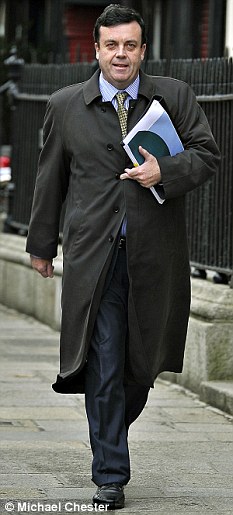
Brian Lenihan
Crisis: Insiders fear Brian Lenihan fails to grasp the dangers
Ireland's biggest banks are facing collapse this week unless an immediate international bail-out package can be agreed, senior insiders have revealed.
Allied Irish Banks and Bank of Ireland have each suffered a multibillion-euro ‘run’ as foreign investors withdraw their cash amid fears that both institutions are effectively bust.
It was this secret ‘run’ that brought the IMF and EU bail-out teams to Ireland in an effort to prevent the banks collapsing entirely. If they do, it would trigger Ireland’s €440bn blanket bank guarantee – potentially leaving the State unable to pay the debt.
One option available to the IMF would be to ‘lock down’ the Irish banks until a deal is agreed to recapitalise them. In an IMF-led bail-out in Argentina in 2002, banks were shut for 10 days to halt the flight of deposits.
The Government is desperate to play down the scale of the banking crisis because even talking about it could panic personal depositors into withdrawing their cash – even though it is guaranteed by the State.
But some bank insiders fear that ministers – many of whom spent the day canvassing in Donegal yesterday – have simply failed to grasp how close they are to the abyss.
The Irish Mail on Sunday has learned that a colossal €18bn in deposits was withdrawn from Irish banks during September alone.
On Friday, AIB admitted that since June, €12bn had been withdrawn – around a fifth of its entire deposit base. BoI admitted it had lost €10bn in corporate deposits over the August/September period, while Irish Life & Permanent lost about €600m.
The ‘secret run’ forced the banks to borrow tens of billions from the ECB to stay afloat. When Frankfurt recently refused to lend more cash, the Irish Central Bank stepped in with loans of some €28bn to keep them afloat.
However, the ECB is now insisting on withdrawing these loans – which is why the IMF and EU are being asked to step in and take their place.
A source in AIB told the MoS before the release of the interim figures this week: ‘Deposits have been withdrawn in their droves. In the normal course of events, that would be it – the bank is going under. Consideration was given to issuing a statement but it was decided against. We’ll see what the IMF does.’
It is understood that a number of drastic measures are on the table to avoid a situation whereby cash machines simply stop dispensing.
Central Bank governor Patrick Honohan said on Thursday that Ireland was likely to accept a loan for ‘tens of billions of euro’ from the IMF and European Stability Fund.
One source said: ‘He had to make the announcement to try to alleviate the outflow of deposits. The Government can’t seem to grasp this. They don’t seem to understand even the basics of how banking works and their incompetence is frightening.’
But other insiders note that the Government had been stressing all week that the IMF team was here to talk about a banking bail-out, rather than a sovereign one – which shows that the real problem is the scale of debts run up by the banks, rather than State spending.
However, as Brian Lenihan guaranteed all bank loans and deposits in November 2008, their debts are effectively State debts.
Neither AIB nor BoI would respond directly to questions yesterday about their solvency.
A BoI spokeswoman said: ‘We said at our trading update that we lost some deposits in the capital markets area at the end of August but that it had stabilised at the end of September.’
Asked if the bank was in a position to cover all of its deposits, she said: ‘We don’t go outside of reporting times in terms of what we say.’
A spokesman for AIB said the bank could not comment beyond this week’s interim statement. That said: ‘…Our funding and liquidity positions have been positively affected by specific recent events and will be further positively impacted by events expected to occur over the coming months.
Our previously announced planned equity capital raising is expected to generate cash of €3.7bn. In the first half of 2011, we expect to receive €3.1bn in cash from the agreed sale of our Polish business.’
A spokesman for the Department of Finance said: ‘The whole banking issue is being looked at so one would have to surmise that whatever agreement comes out of these talks… will result in a solution for the banks.’
Asked about an Argentinian style solution of closing banks’ doors he said: ‘I don’t think you’ll see that scenario no.’
But in May, economist Morgan Kelly – who predicted the property crash – said the scale of banking debt would drag the country under.
He wrote: ‘It is no longer a question of whether Ireland will go bust but when. Unlike Greece, our woes do not stem from Government debt but instead from the Government’s open-ended guarantee to cover the losses of the banking system out of its citizens’ wallets. What will sink us, unfortunately but inevitably, are the huge costs of the bank bail-out.’
And writing in today’s MoS, leading analyst Megan Greene – who predicted the IMF/EU bail-out three weeks ago – said that while a bail-out would provide Ireland with a couple of years’ breathing space, eventually the scale of our debts would overwhelm our ability to repay.
The front doors of the Department of Finance on Merrion Street closed at 5.30 last night. Asked if Brian Lenihan was still inside, the doorman said: ‘Yes, it’s going to be a marathon.’


Read more: http://www.dailymail.co.uk/news/article-1331690/Ireland-bailout-Banks-brink-collapse.html#ixzz15vIYrnYg
*****************************************************************************

Ireland Will Pursue Aid From Europe, Minister Says


Speaking on Ireland's RTE radio, Mr. Lenihan said the application would be approved at a cabinet meeting this afternoon in Dublin.  
He would not give an exact figure but said the amount would be in the tens of billions of euros and that the final figure was still subject to further negotiations.  
His announcement ends a feverish bout of speculation here on how the rescue talks have taken on extra pace this weekend as the depth of the Ireland's banking problems became known to the IMF and and European officials. People briefed on the talks say that the fear has grown that without swift and immediate action, a full-fledged banking panic might materialize on Monday.
“The language has changed,” said Michael Noonan, the chief economic spokesman for Fine Gael, the main opposition party. “It is no longer about putting more capital in the banks – we are past that now.”
According to data from the Irish Central Bank and the European Central Bank, the six troubled Irish banks have markedly increased their reliance on outside funds in order to stem a wave of deposit withdrawals that have picked in the last week
E.C.B. data shows that 130 billion euros have been funneled to Irish banks, with 95 billion euros being directed to the large, locally based banks. With deposits on the wane and outside funding lines cut off, these banks are wholly dependent on Europe for their survival, running up loan to deposit ratios that now exceed 160 percent above and beyond prudential bank guidelines.
On Nov. 12, Bank of Ireland reported that its outside borrowings had increased by 12 billion euros, or 11 percent of its assets. And on Nov. 19, Allied Irish Bank reported that its extra borrowings were 27 billion euros or 16 percent of its balance sheet.
Barclays Capital estimates that 28 billion euros in extra funding is going to Anglo Irish – the troubled real estate lender that has chalked up over 30 billion in failed loans.
Anglo Irish has been fully nationalized and the government has pinned much of Ireland’s troubles on it. Evidence now that deposit flight is gaining speed at Allied Irish and Bank of Ireland comes as another shock of bad news to Irish authorities and it has pushed the issue of the banks ahead of finalizing the four year plan as the chief problem to be addressed.
The government has announced a cabinet meeting for 3 p.m. Sunday in Dublin, but people who have been briefed on the discussions now say that the bank problem will be the main issue for discussion. There is also talk that the executives of the Irish banks have been told to stand ready in case extraordinary action is taken sooner rather than later.
A spokesman in the prime minister's office said he had no knowledge of any changed focus in the talks, or that bank executives had been alerted. A spokesman for the finance ministry did not respond to a request for comment.
What a bank plan would look like is unclear.
Prime Minister Brian Cowen said on Saturday that some form of a contingency fund was likely. Now, it would seem that the main aim of the fund would be to either sink further amounts of capital into the banks or perhaps something more radical that would involve forced mergers or a type of fire sale to an outside investor.
Some analysts feel that that the extent of the banks’ losses has been overstated. Goldman Sachs issued a much remarked upon report last week which said that NAMA, the government body responsible for buying the band loans from the Irish banks, had overestimated their losses.
“That is the first time anyone has said that,” said John Fitzgerald, an economist at the Economic and Social Research Institute in Dublin.
All the same, on the ground here – as the negotiations continue – Dubliners, who are now well into their third consecutive year of negative growth, are calling for some form of action to restore calm.
“If I had a lump sum of money now, I would be very nervous about putting it in an Irish bank,” said Brian Kavanagh a 60 year old cab driver. “There is just no confidence in the banking sector here.”
*****************************************************************************
The Minister for Finance has confirmed that Ireland will be applying for a financial rescue package from the EU, the International Monetary Fund and the European Central Bank.
Speaking on RTE's This Week, Brian Lenihan said he will propose the application to this afternoon's meeting of the Cabinet.
The Minister confirmed that discussions with the agencies had concluded yesterday evening.
Ireland would now be formally applying for a rescue programme and formal negotiations will begin.
He confirmed that the amount of money involved amounted to 'tens of billions' of euros but denied suggestions it would be as much as €70 or €80 billion.
He suggested most of the money would be used to cover the Government deficit for the next few years, while most of the money assigned to the banks would be from what he called a 'demonstration of firepower' that would only be drawn down if required.
Mr Lenihan added that there would have to be structural changes to the Irish banking sector as part of a 'detailed resolution scheme'.
The Minister said he had not misled the country over the past week nor did any of his cabinet colleagues intend to mislead people.
He said it would the height of irresponsibility to have a General Election now, and that the priorities for the country were having the four-year plan and Budget in place.
Mr Lenihan said no concrete figure had been arrived at and that figure would be the subject of negotiations.
He described the funding being applied for 'a standby fund' and said not all of it would necessarily be drawn down.
The minister said the European Central Bank was behind the Irish banking system and capital was needed to ensure the Irish banks had 'firepower'.
However, he said banks had to be 'weaned' away from central bank funding.
The amount of interest being charged was also subject to negotiation but it would be 'a lot less' that we would have paid on the international markets.
Mr Lenihan welcomed comments yesterday from German Chancellor Angela Merkel and French President, Nicolas Sarkozy, on corporation tax and said 'The rate is not on the agenda'.
He also said the minimum wage would have to be looked at.
'It increased far beyond the rate of inflation' over recent years, he said.
The Minister for the Environment has said he expects the programme suggested by Mr Lenihan to be accepted and formulised by the Cabinet this afternoon.
Arriving at Government Buildings, John Gormley said he could fully understand that there is a great deal of concern amongst the public because, he said, communications last weekend surrounding the situation were poor.
He also said he was concerned about cost cutting measures but said it had to be remembered that room for manoeuvre was limited because it was hard to appeal to market sentiments.
Fine Gael spokesman on Finance Michael Noonan said restructuring the banking system would be central as there appeared to be a move away from putting money into the banks.
He also said that he would not be surprised if the IMF would have something dramatic to announce in the next while.

NJ pastor who told married church leaders to drop Facebook or resign acknowledges threesome

NJ pastor who told married church leaders to drop Facebook or resign acknowledges threesome


NEPTUNE TOWNSHIP, N.J. (AP) — A pastor who said Facebook was a "portal to infidelity" and told married church leaders to delete their accounts or resign once testified that he had a three-way sexual relationship with his wife and a male church assistant.

The Rev. Cedric Miller confirmed the information reported Saturday by the Asbury Park Press of Neptune, which cited testimony he gave in a criminal case in 2003. The relationship had ended by that time.

Miller gained national attention when he issued the Facebook edict this week. He said it came about because much of the marital counseling he has performed over the past year and a half has concerned infidelity stemming from the social-networking website.

The 48-year-old leader of Living Word Christian Fellowship Church in Neptune Township had claimed Facebook ignites old passions, and he ordered about 50 married church officials to delete their accounts with the social networking site or resign from their leadership positions.

Miller had previously asked married congregants to share their login information with their spouses — as he does — and now plans to suggest that they give up Facebook altogether. The minister also said he would leave the site this week.

In court testimony he gave in April 2003, Miller said his wife had an extramarital affair with the church assistant. Miller said he participated in many of the sexual encounters and said the assistant's wife was sometimes present, too.

Miller said the dalliances — which occurred in the Millers' home — sometimes took place during Thursday Bible study meetings and Sundays after church. But the minister said the encounters "came to a crashing halt" when several women in the church accused the assistant of having sex with them.

The testimony was given in connection with a criminal case against the assistant that was eventually dismissed. The names of the church assistant and his wife were not disclosed, and Miller told the newspaper that he was concerned that revisiting the incident would "irreparably" hurt some people.

"It has come to my attention that a very painful part of my past has resurfaced," Miller wrote in an e-mail sent Friday. Noting that his court testimony was mailed to his church leaders and other pastors several years ago, Miller said, "This was resolved at that time and accordingly we will not allow it to detract from our mission at hand to save as many marriages as we can."

Miller said people must look at his Facebook directives in the proper context.

"My life as a minister, husband, father and friend has led me to the conviction that I must do all that I can to help as many people strengthen, preserve and repair the often times fragile cords of marriage," Miller wrote.

A message left by The Associated Press for the church's pastor was not immediately returned Saturday.

___